
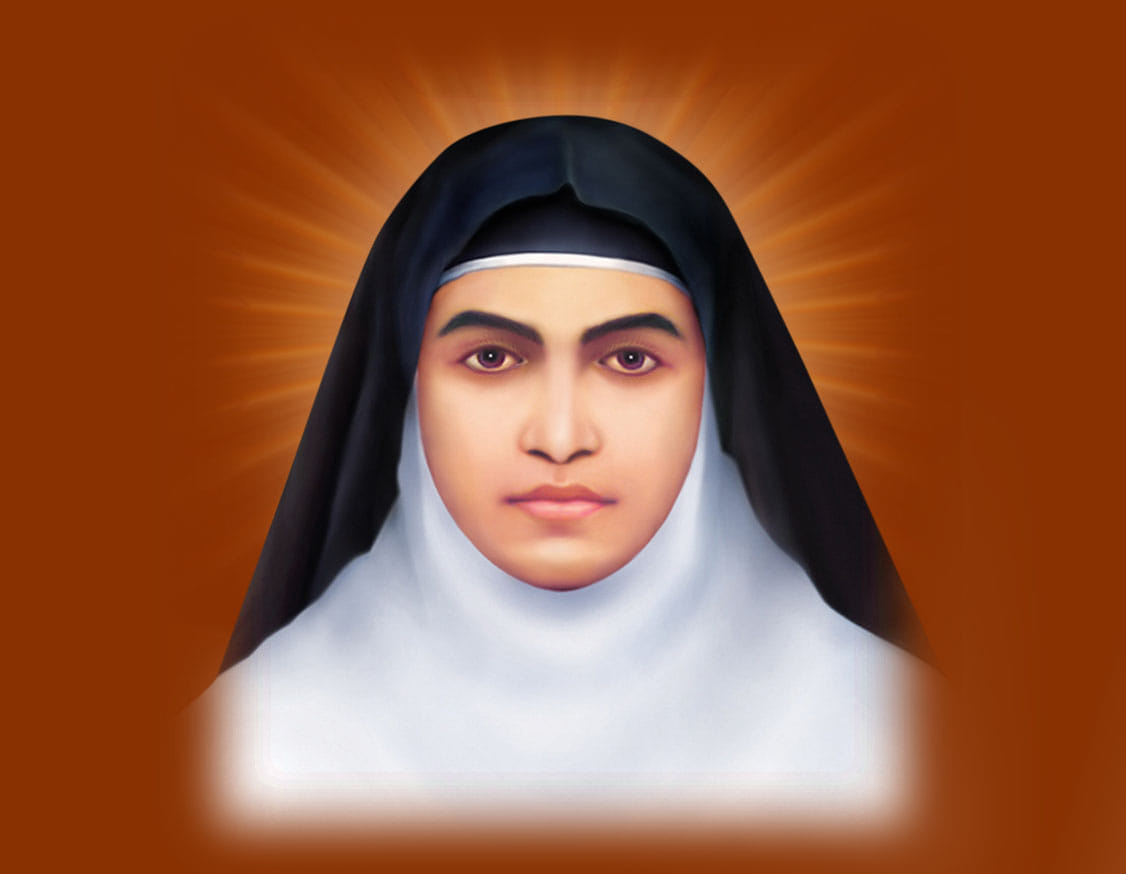
Part VI – A Life of Prayer, Silence, and Absolute Trust in Divine Providence
“Jesus is my only refuge.”
— Faithful English rendering from the prayers and correspondence of Saint Alphonsa (wording varies among published translations).
Introduction
If suffering was the Cross that shaped Saint Alphonsa’s life, prayer was the strength that enabled her to carry it.
No one can endure prolonged illness, repeated disappointments, hidden sacrifices, and spiritual trials through human determination alone. Such perseverance is possible only when one’s life is deeply rooted in God.
Saint Alphonsa’s remarkable serenity did not arise from a naturally optimistic personality. It flowed from a life immersed in prayer, nourished by silence, and sustained by unwavering confidence in Divine Providence.
To those who met her, she appeared gentle, peaceful, and deeply recollected. Behind this calm exterior was a woman who spent every moment seeking communion with God. Prayer was not merely one activity among many; it was the atmosphere in which she lived.
Her example reminds us that holiness is not achieved by extraordinary works alone but by an ordinary life continually offered to God in prayer.
Prayer: The Breath of Her Soul
The Catechism of the Catholic Church describes prayer as “the living relationship of the children of God with their Father” (CCC 2565).
This definition perfectly describes Saint Alphonsa’s spiritual life.
Prayer was not merely the recitation of familiar formulas. It was a living conversation with Christ.
She prayed:
- in times of joy,
- in moments of pain,
- during illness,
- while performing ordinary duties,
- in silence before the Blessed Sacrament,
- during the Holy Qurbana,
- before making decisions,
- while interceding for others.
Everything became prayer.
Saint Paul writes:
“Pray without ceasing.” (1 Thessalonians 5:17)
Saint Alphonsa sought to live this command literally.
Prayer Beyond Words
Many people imagine prayer as speaking to God.
Saint Alphonsa understood that authentic prayer also includes listening.
Silence occupied an important place in her spiritual life.
She recognized that God’s voice is often heard not amid noise but within the quietness of the heart.
This recalls the experience of the Prophet Elijah.
God was not found in the wind,
nor in the earthquake,
nor in the fire,
but in “a still small voice” (1 Kings 19:11–13).
Saint Alphonsa cultivated this interior silence throughout her life.
Silence as a Path to God
Modern life is filled with constant activity.
Television.
Social media.
Mobile phones.
Endless information.
The soul easily becomes distracted.
Saint Alphonsa lived in a different age, yet she intentionally embraced silence because she understood its spiritual value.
Silence enabled her:
- to examine her conscience,
- to meditate on Scripture,
- to listen to God’s inspirations,
- to grow in humility,
- to avoid unnecessary conflicts.
For her, silence was never emptiness.
It was the space where God spoke.
Silence During Misunderstanding
One of the most admirable features of Saint Alphonsa’s character was her restraint when misunderstood.
There were occasions when false judgments or criticism caused her pain.
Yet she rarely defended herself.
Instead, she entrusted everything to God.
Her silence reflected the example of Christ, who remained remarkably silent before Pilate and His accusers.
Isaiah had foretold this centuries earlier:
“Like a lamb that is led to the slaughter… He opened not His mouth.” (Isaiah 53:7)
Saint Alphonsa understood that silence, when joined with charity, can become a powerful witness of faith.
Trust in Divine Providence
Perhaps no virtue shines more beautifully in Saint Alphonsa’s writings than her confidence in God’s providence.
Divine Providence refers to God’s loving care by which He guides all creation toward its ultimate purpose.
Saint Alphonsa believed that nothing entered her life outside God’s loving permission.
This did not mean she understood every suffering.
She did not.
But she trusted the One who did.
The Book of Proverbs teaches:
“Trust in the Lord with all your heart, and do not rely on your own understanding.” (Proverbs 3:5)
Saint Alphonsa lived these words every day.
Faith in Times of Uncertainty
There were many moments when Saint Alphonsa had no human reason for optimism.
Her health deteriorated repeatedly.
Medical treatment often brought only temporary relief.
Physical weakness limited her activities.
Yet despair never gained control of her heart.
Her confidence rested not in favorable circumstances but in God’s promises.
This reflects the words of the Psalmist:
“God is our refuge and strength, a very present help in trouble.” (Psalm 46:1)
Confidence Without Presumption
Christian trust differs from presumption.
Saint Alphonsa trusted God completely, yet she never demanded that God act according to her wishes.
She accepted medical care.
She prayed for healing.
But she ultimately surrendered every outcome to God’s will.
This mature faith echoes Christ’s own prayer in Gethsemane:
“Not My will, but Yours be done.” (Luke 22:42)
Such trust does not eliminate uncertainty.
It transforms uncertainty into hope.
Prayer During Illness
Illness became one of Saint Alphonsa’s greatest schools of prayer.
When physical strength failed, prayer remained possible.
Indeed, suffering often deepened her communion with God.
She discovered that weakness need not become an obstacle to holiness.
Instead, weakness became the place where God’s grace was most evident.
Saint Paul learned the same lesson when Christ told him:
“My grace is sufficient for you, for power is made perfect in weakness.” (2 Corinthians 12:9)
Saint Alphonsa experienced this truth personally.
Intercessory Prayer
Saint Alphonsa rarely prayed only for herself.
Her letters reveal constant concern for others.
She prayed:
- for priests,
- for bishops,
- for religious,
- for her family,
- for benefactors,
- for the sick,
- for sinners,
- for those experiencing difficulties.
She believed that prayer united the entire Church.
Even while confined by illness, she continued serving others through intercession.
This beautifully reflects Saint Paul’s instruction:
“Pray for one another.” (James 5:16)
Prayer Before the Eucharist
Saint Alphonsa’s prayer reached its highest expression in the Holy Eucharist.
Before the Blessed Sacrament she found peace.
There she entrusted every sorrow to Christ.
The Eucharist became the meeting place between human weakness and divine mercy.
Like the disciples on the road to Emmaus, she recognized the Lord in the breaking of the bread (Luke 24:30–35).
Her Eucharistic devotion nourished every other aspect of her spiritual life.
Trust During Spiritual Dryness
Every mature Christian experiences periods when prayer feels difficult.
Saint Alphonsa knew such moments.
She did not abandon prayer simply because consolation disappeared.
Instead, she remained faithful.
This perseverance demonstrates authentic love.
Love seeks the beloved even when emotions grow quiet.
The Psalms frequently express this longing:
“My soul thirsts for God, for the living God.” (Psalm 42:2)
Saint Alphonsa’s fidelity during spiritual dryness became one of her greatest acts of faith.
Living in God’s Presence
Perhaps the most remarkable aspect of Saint Alphonsa’s spirituality was her constant awareness of God’s presence.
She did not divide life into “prayer time” and “ordinary time.”
Everything belonged to God.
Every task.
Every conversation.
Every suffering.
Every joy.
This practice resembles what Brother Lawrence described as “the practice of the presence of God.”
For Saint Alphonsa, every moment became an opportunity to remain united with Christ.
Lessons for Christians Today
Saint Alphonsa’s witness offers practical guidance for believers navigating the distractions of modern life.
1. Begin and End Each Day with Prayer
Prayer need not be lengthy.
A few moments of sincere conversation with God can transform an entire day.
2. Rediscover Holy Silence
Set aside moments without distractions.
Silence prepares the heart to hear God’s voice.
3. Trust God Even Without Answers
Faith does not require understanding every circumstance.
It requires confidence in God’s goodness.
4. Make Intercession Part of Daily Prayer
Like Saint Alphonsa, remember:
- your family,
- your parish,
- priests,
- missionaries,
- the sick,
- those who have no one to pray for them.
5. Stay Faithful During Spiritual Dryness
Prayer is an act of love, not merely emotion.
Continue praying even when consolation is absent.
God is still present.
Reflection Questions
- Is prayer the foundation of my daily life?
- Do I intentionally create moments of silence to listen to God?
- How do I respond when prayers seem unanswered?
- Do I trust God’s providence even during uncertainty?
- Whom can I remember in prayer today?
Prayer Inspired by Saint Alphonsa
Heavenly Father,
Through the example of Saint Alphonsa, teach us to seek You above all else.
Deepen our love for prayer and help us to discover Your presence in silence.
When our hearts are troubled, become our refuge.
When life is uncertain, strengthen our trust.
When suffering overwhelms us, remind us that Your providence never fails.
Grant us the grace to pray faithfully, to listen attentively, and to walk confidently along the path You have prepared for us.
May every moment of our lives become an offering of praise to You.
Through Christ our Lord.
Amen.
Saint Alphonsa’s Wisdom for Today’s World
In an age marked by noise, anxiety, and constant distraction, Saint Alphonsa offers a timeless invitation:
- Pray before reacting.
- Listen before speaking.
- Trust before worrying.
- Hope before despairing.
- Place every burden into God’s hands.
Her life demonstrates that peace is not found in perfect circumstances but in perfect confidence in God’s loving care.
Key Takeaways
- Prayer was the center of Saint Alphonsa’s spiritual life and sustained her through every trial.
- She understood silence as an essential means of listening to God and growing in holiness.
- Her unwavering trust in Divine Providence enabled her to face suffering with peace and hope.
- She devoted herself to intercessory prayer for priests, religious, families, and those in need.
- Her example encourages Christians to cultivate a continual awareness of God’s presence in everyday life.
Preview of Part VII
In Part VII, we will explore Saint Alphonsa’s charity, forgiveness, and love for the Church. We will examine how she practiced mercy toward those who misunderstood her, her deep concern for priests and religious vocations, and the enduring lessons her life offers for Christian communities today.
References
- Holy Bible (NRSV Catholic Edition or another approved Catholic translation): 1 Thessalonians 5:17; 1 Kings 19:11–13; Isaiah 53:7; Proverbs 3:5; Psalm 46:1; Luke 22:42; 2 Corinthians 12:9; James 5:16; Luke 24:30–35; Psalm 42:2.
- Catechism of the Catholic Church, §§2558–2565 (The Nature of Prayer), §§2683–2696 (Prayer in the Christian Life).
- Pope Benedict XVI, Homily for the Canonization of Saint Alphonsa, 12 October 2008.
- Congregation for the Causes of Saints, Positio super Vita, Virtutibus et Fama Sanctitatis Servae Dei Alphonsae Muttathupadathu.
- Franciscan Clarist Congregation (FCC), official biographies, letters, and spiritual writings of Saint Alphonsa.
- Syro-Malabar Church, official liturgical and historical publications on Saint Alphonsa.
- The Practice of the Presence of God by Brother Lawrence (for comparison regarding continual awareness of God’s presence, not as a source for Saint Alphonsa’s writings).
Leave a Reply