
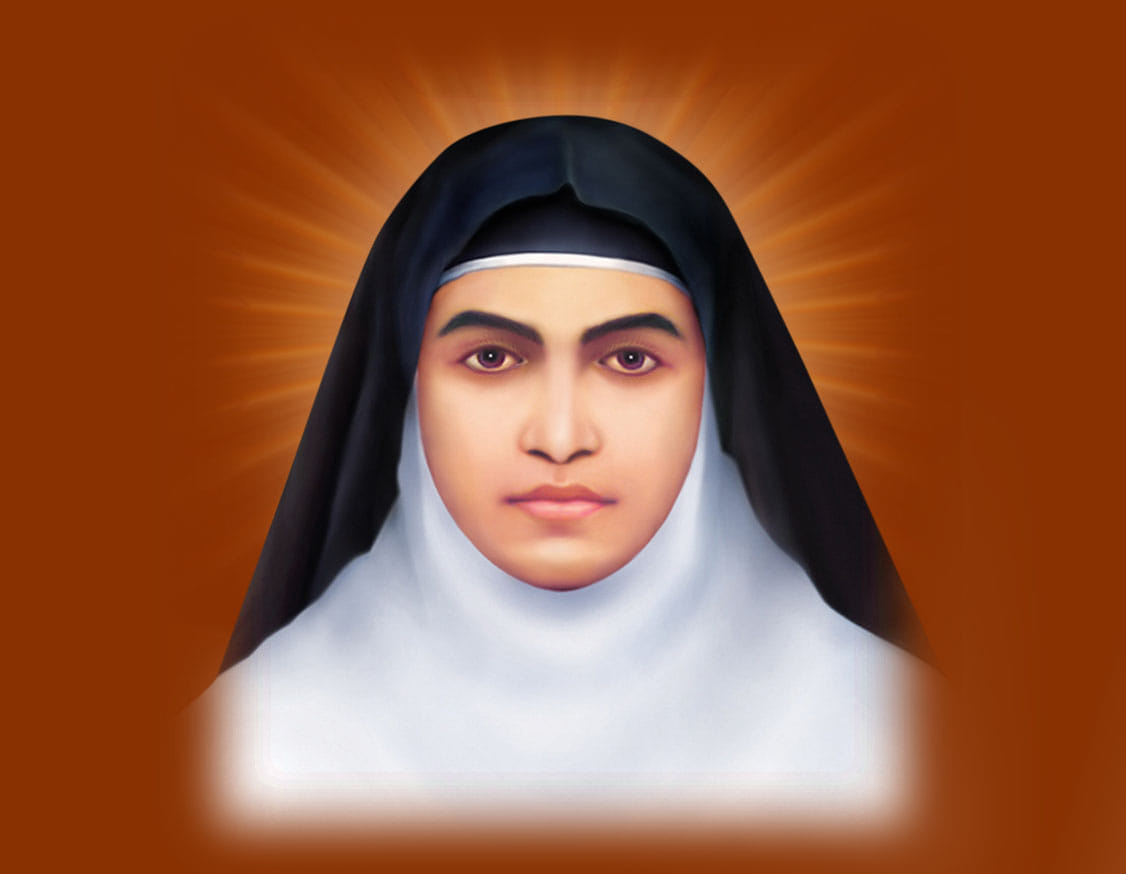
Part II – Complete Surrender to God: The Foundation of Saint Alphonsa’s Spiritual Life
“May the will of God alone be fulfilled in me.”
— Saint Alphonsa (from her correspondence; wording varies slightly among published translations)
Introduction
Every saint has a central spiritual characteristic that shapes his or her entire journey toward holiness. For Saint Francis of Assisi, it was evangelical poverty. For Saint Thérèse of Lisieux, it was the “Little Way” of spiritual childhood. For Saint Teresa of Calcutta, it was seeing Christ in the poorest of the poor.
For Saint Alphonsa, it was complete surrender to the will of God.
This was not merely an admirable virtue among many others. It was the very foundation upon which her entire spiritual life rested. Every decision she made, every illness she endured, every misunderstanding she experienced, and every prayer she offered flowed from her unwavering conviction that God’s will is always wiser, holier, and more loving than our own.
Her writings reveal no spirit of bitterness or resentment. Instead, they reveal a woman who had learned the difficult but liberating lesson taught by Christ Himself: true freedom is found in obedience to the Father’s will.
The Meaning of Surrender in Christian Spirituality
In modern language, the word “surrender” often suggests defeat or weakness. Spiritually, however, surrender has an entirely different meaning.
Christian surrender is not giving up.
It is giving oneself over to God in trust.
The Catechism of the Catholic Church teaches that faith is fundamentally an act of entrusting oneself to God (CCC 150). This trust becomes visible when believers freely choose God’s will, even when it is difficult or mysterious.
Jesus Himself gave the perfect example.
In the Garden of Gethsemane He prayed:
“Father, if You are willing, remove this cup from Me; nevertheless, not My will but Yours be done.”
(Luke 22:42)
Saint Alphonsa returned to this mystery throughout her life.
Learning God’s Will Through Suffering
Saint Alphonsa did not discover surrender in a single dramatic moment.
It developed gradually through years of suffering.
She experienced:
- the loss of her mother during infancy,
- physical illness from childhood,
- emotional loneliness,
- misunderstanding within community life,
- repeated hospitalizations,
- constant bodily pain.
Each circumstance became a school of trust.
Rather than asking,
“Why has God abandoned me?”
she learned to ask,
“Lord, what do You desire to accomplish through this?”
That subtle difference transformed her entire life.
An Authentic Witness from Her Letters
Among the recurring themes in Saint Alphonsa’s correspondence is her desire that God’s will should prevail over every personal preference.
One faithful English rendering reads:
“May the will of God alone be fulfilled in me.”
Although brief, this sentence summarizes her entire spirituality.
Notice what she does not pray.
She does not ask:
- for health,
- for comfort,
- for success,
- for recognition,
- for relief from suffering.
Instead she desires only one thing:
that God’s will be accomplished.
This reflects the Blessed Virgin Mary’s response to the Angel Gabriel:
“Behold, I am the servant of the Lord; let it be done to me according to your word.”
(Luke 1:38)
Like Mary, Alphonsa understood that holiness begins with a generous “yes.”
Surrender Does Not Eliminate Suffering
A common misunderstanding among Christians is the belief that holiness should protect a person from suffering.
Saint Alphonsa’s life teaches exactly the opposite.
The closer she drew to Christ, the more intimately she shared His Cross.
Yet she never interpreted suffering as God’s punishment.
Instead, she understood it as participation in Christ’s redemptive love.
This reflects the teaching of Saint Peter:
“Rejoice insofar as you are sharing Christ’s sufferings.”
(1 Peter 4:13)
Her surrender did not remove pain.
It gave pain meaning.
The Freedom Found in God’s Will
Modern culture often identifies freedom with unlimited choice.
Christian spirituality offers a deeper understanding.
Freedom is not the ability to do whatever we want.
Freedom is the ability to choose what is truly good.
Saint Alphonsa discovered that when she stopped resisting God’s plans, her heart became peaceful even amid suffering.
Her peace did not depend upon circumstances.
It depended upon trust.
This echoes the words of Isaiah:
“You keep him in perfect peace whose mind is stayed on You.”
(Isaiah 26:3)
The Humility That Made Surrender Possible
Complete surrender is impossible without humility.
Pride insists,
“My way is best.”
Humility prays,
“Lord, teach me Your way.”
Throughout her religious life, Saint Alphonsa accepted:
- corrections,
- misunderstandings,
- hidden service,
- obscurity.
She never sought prominence.
Her humility resembled that of Christ,
“Who humbled Himself and became obedient unto death—even death on a cross.”
(Philippians 2:8)
Because she humbled herself before God, she discovered extraordinary spiritual freedom.
Surrender in Daily Life
Saint Alphonsa did not limit surrender to extraordinary moments.
She practiced it every day.
Every ordinary duty became an opportunity to say yes to God.
Whether she was praying,
working,
resting,
suffering,
or serving her community,
she desired only to please Christ.
This is why her holiness is accessible to everyone.
She demonstrates that sanctity is not reserved for missionaries, theologians, or martyrs.
It begins with faithfulness in ordinary responsibilities.
As Jesus taught:
“Whoever is faithful in very little is faithful also in much.”
(Luke 16:10)
Lessons for Christians Today
Saint Alphonsa’s example offers practical guidance for modern believers.
1. Accept What Cannot Be Changed
Not every difficulty has an immediate solution.
Instead of becoming discouraged,
we can entrust difficult situations to God.
Acceptance is not passive resignation.
It is confident trust.
2. Pray Before Complaining
Saint Alphonsa consistently turned toward prayer before reacting emotionally.
Prayer gave her perspective.
Modern Christians can imitate this habit.
3. Seek God’s Will Above Personal Preference
Many important decisions involve uncertainty.
Rather than asking,
“What do I want?”
Christians are invited to ask,
“Lord, what leads me closer to You?”
This simple shift transforms decision-making.
4. Trust During Seasons of Silence
God sometimes appears silent.
Saint Alphonsa experienced this.
Yet silence did not weaken her faith.
It deepened it.
She reminds believers that God is often working most powerfully when He seems least visible.
5. Live One Day at a Time
Saint Alphonsa rarely worried about distant years.
She entrusted tomorrow to God.
She remained faithful today.
This reflects Jesus’ teaching:
“Do not worry about tomorrow.”
(Matthew 6:34)
Reflection for Personal Prayer
Take a few moments to ask yourself:
- Am I resisting something that God is asking me to accept?
- Do I seek God’s will before making important decisions?
- Can I trust God even when I do not understand His plans?
- Have I learned to pray, “Your will be done,” from my heart?
Saint Alphonsa reminds us that surrender is not a single act but a lifelong journey.
Each day offers another opportunity to place our lives into God’s loving hands.
Prayer Inspired by Saint Alphonsa
Lord Jesus,
You accepted the Father’s will even when it led You to the Cross.
Teach us to trust You as Saint Alphonsa trusted You.
When we experience suffering, grant us patience.
When we face uncertainty, grant us confidence.
When we struggle with disappointment, grant us peace.
May we seek not our own desires but Your holy will in every circumstance of life.
Transform our hearts into generous offerings of love, so that every joy, every sacrifice, and every ordinary duty may glorify You.
Through the intercession of Saint Alphonsa, strengthen us to say each day:
“Your will be done.”
Amen.
Key Takeaways
- Complete surrender to God was the foundation of Saint Alphonsa’s spirituality.
- She viewed suffering as an opportunity to unite herself more closely with Christ.
- Her writings consistently emphasize trust in Divine Providence rather than worldly success.
- Humility made her surrender possible.
- Her example shows that holiness is achieved through daily faithfulness, not extraordinary accomplishments.
Preview of Part III
In the next chapter, we will explore Saint Alphonsa’s theology of suffering—one of the most profound dimensions of her spiritual life. We will examine how she understood the Cross, why she willingly offered her sufferings for priests and sinners, and how her witness can help Christians find hope amid illness, grief, and life’s deepest trials.
References
- Holy Bible (NRSV Catholic Edition or another approved Catholic translation): Luke 22:42; Luke 1:38; Philippians 2:8; Luke 16:10; Matthew 6:34; Isaiah 26:3; 1 Peter 4:13.
- Catechism of the Catholic Church, §§150–152 (Faith as personal adherence to God).
- Congregation for the Causes of Saints. Positio super Vita, Virtutibus et Fama Sanctitatis Servae Dei Alphonsae Muttathupadathu.
- Pope Benedict XVI, Homily for the Canonization of Saint Alphonsa, 12 October 2008.
- Franciscan Clarist Congregation (FCC), official biographical publications on Saint Alphonsa.
- Syro-Malabar Church, official liturgical and historical resources on Saint Alphonsa.
Leave a Reply