
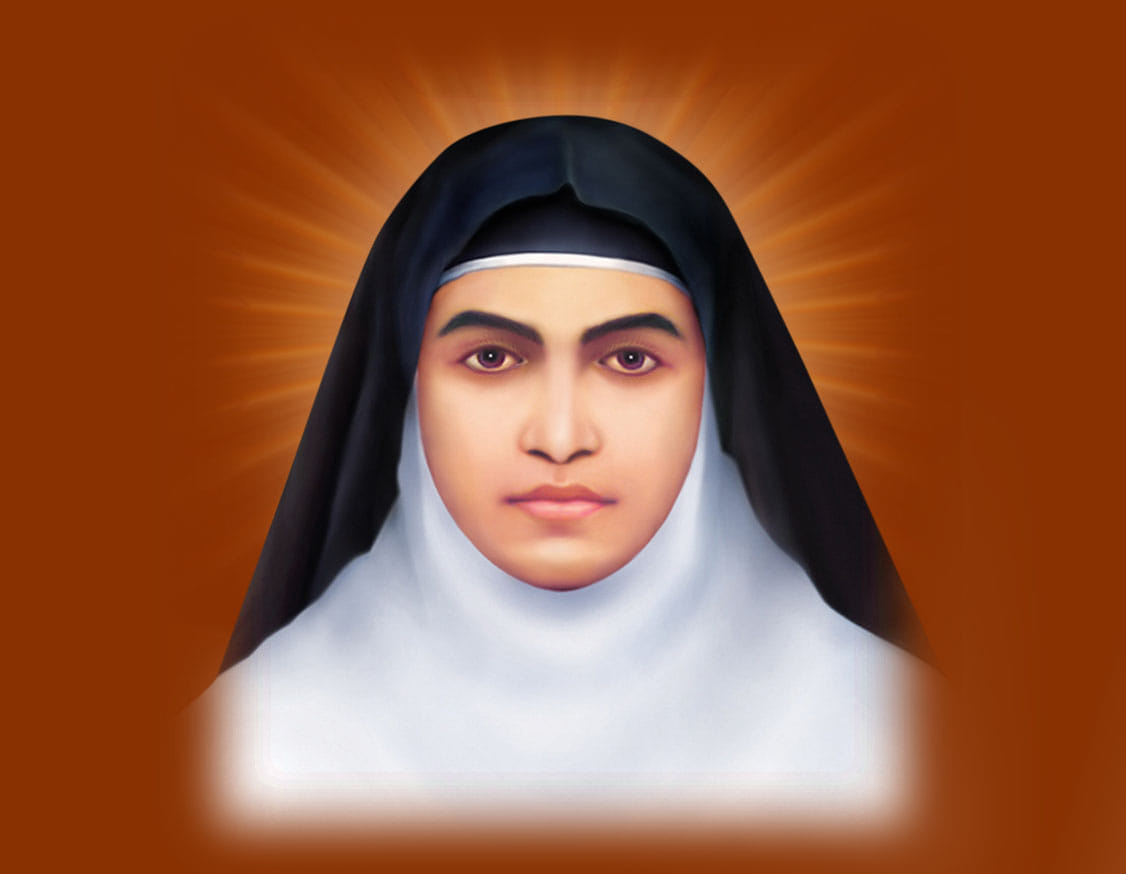
Part I – Discovering the Voice of India’s First Woman Saint
Introduction
Among the countless saints who have illuminated the history of the Catholic Church, Saint Alphonsa of the Immaculate Conception (1910–1946) occupies a unique place. She was the first woman of Indian origin to be canonized by the Catholic Church and remains one of the most beloved saints of the Syro-Malabar Church. Her life was neither marked by extraordinary public miracles nor by extensive theological writings. Instead, her holiness blossomed in the quiet obscurity of convent life, where every joy, sorrow, illness, misunderstanding, and sacrifice became an offering of love to Jesus Christ.
Unlike great spiritual authors such as St. Augustine, St. Teresa of Ávila, or St. Thérèse of Lisieux, Saint Alphonsa left behind only a modest collection of writings. Her surviving legacy consists primarily of personal letters, retreat notes, prayers, and brief spiritual reflections. Yet these simple writings reveal a soul profoundly united with God. Every sentence radiates humility, unwavering trust, and an extraordinary love for Christ.
In an age fascinated by success, recognition, and comfort, Saint Alphonsa speaks with remarkable relevance. She teaches that true greatness lies not in worldly achievement but in faithful discipleship. Her spirituality invites Christians to discover God’s presence in ordinary duties, hidden sacrifices, and patient endurance.
This article explores the authentic spiritual wisdom of Saint Alphonsa by examining her genuine writings, placing them within their historical context, and reflecting on their enduring significance for Christians today.
Why Saint Alphonsa’s Words Matter Today
Modern society often measures happiness by wealth, health, influence, or personal accomplishment. Success is celebrated, while suffering is usually seen as something to avoid at all costs. Against this cultural backdrop, Saint Alphonsa offers a radically different perspective.
She never sought fame. She never founded a religious congregation. She never preached to large crowds. She never wrote celebrated theological works.
Instead, she embraced what Pope Benedict XVI described during her canonization as a life completely transformed by union with Christ, especially through participation in His suffering.
Her message remains deeply relevant because she answers questions that every generation asks:
- Why does God permit suffering?
- How can we remain faithful during illness?
- What gives meaning to hidden sacrifices?
- How can ordinary people become saints?
- What does complete trust in God actually look like?
Saint Alphonsa’s life provides answers not through abstract arguments but through lived experience.
A Saint Formed by the Cross
Saint Alphonsa was born Anna Muttathupadathu on 19 August 1910 at Kudamaloor, in present-day Kerala, India. From childhood she experienced suffering.
Within three months of her birth, she lost her mother.
Raised by relatives, she grew up surrounded by deep Christian faith but also personal hardships. Even as a child she desired to dedicate herself entirely to God.
One of the defining moments of her youth occurred when she deliberately burned her feet with embers, hoping to avoid an arranged marriage and preserve her vocation to religious life. The severe injuries permanently affected her health, beginning decades of physical suffering.
Throughout her life she endured:
- recurring fevers,
- digestive disorders,
- severe infections,
- physical weakness,
- emotional misunderstandings,
- periods of isolation,
- spiritual darkness.
Yet she interpreted none of these as meaningless.
Instead, she united every trial with the suffering of Christ.
This became the central theme of her spirituality.
The Hidden Treasure of Her Writings
One reason Saint Alphonsa is sometimes misunderstood is that relatively few of her writings survive.
Unlike many Doctors of the Church, she did not intentionally write books for publication.
Her surviving writings include:
- personal letters,
- correspondence with family,
- letters to spiritual directors,
- retreat notes,
- community records,
- prayers,
- testimonies preserved by the Franciscan Clarist Congregation.
These documents reveal remarkable consistency.
Again and again we encounter the same themes:
- complete surrender to God’s will,
- longing for Jesus,
- love of the Eucharist,
- devotion to the Sacred Heart,
- confidence in Divine Providence,
- joyful acceptance of suffering,
- humility,
- prayer,
- intercession for sinners and priests.
Although the language is simple, the spiritual depth is extraordinary.
Authentic Quotations versus Popular Internet Quotes
In recent years hundreds of “Saint Alphonsa quotes” have appeared across websites and social media. Many are beautiful and spiritually uplifting. Unfortunately, a large number cannot be traced to any authentic source.
This presents an important challenge for Catholic publishers.
When words are attributed to a canonized saint without historical evidence, readers may unknowingly accept devotional reflections as authentic quotations.
For this reason, nelsonmcbs.com seeks to distinguish clearly between:
Authentic Quotations
These come directly from:
- surviving letters,
- prayers,
- retreat notes,
- officially documented testimonies,
- reliable biographical sources.
Whenever possible, they should be accompanied by references.
Inspired Reflections
These express Saint Alphonsa’s spirituality but are newly written devotional meditations.
Both have value.
Authentic quotations preserve the saint’s historical voice.
Inspired reflections help modern readers apply her spirituality to daily life.
Maintaining this distinction strengthens both historical integrity and devotional credibility.
The Heart of Saint Alphonsa’s Spirituality
Although her writings cover many topics, four themes appear repeatedly.
1. Total Surrender to God’s Will
Saint Alphonsa never viewed holiness as self-achievement.
Everything begins with surrender.
Her recurring prayer may be summarized as:
“May God’s holy will alone be fulfilled in me.”
This echoes Christ’s own prayer in Gethsemane:
“Not my will but yours be done.” (Luke 22:42)
For Alphonsa, holiness meant allowing God to direct every circumstance of life—even suffering.
2. Love for Jesus Above Everything
Her writings reveal an intensely personal relationship with Christ.
Jesus was not merely a teacher.
He was:
- Lord,
- Savior,
- Friend,
- Divine Bridegroom,
- Companion in suffering.
She desired above everything else to belong completely to Him.
Her spirituality reflects the words of St. Paul:
“For me, to live is Christ.” (Philippians 1:21)
3. Joyful Acceptance of Suffering
Perhaps no aspect of Saint Alphonsa’s life has attracted more attention than her understanding of suffering.
She never glorified pain for its own sake.
Rather, she believed suffering acquires meaning when united with Christ’s sacrifice.
This conviction reflects the teaching of the Apostle Paul:
“I rejoice in my sufferings for your sake…” (Colossians 1:24)
Her life demonstrates that Christian suffering is not passive resignation but active participation in Christ’s redeeming love.
4. Hidden Holiness
Saint Alphonsa never sought recognition.
Most of her life unfolded quietly within convent walls.
Yet her hidden fidelity transformed countless lives.
Her example reminds us of Jesus’ teaching:
“Your Father who sees in secret will reward you.” (Matthew 6:6)
Holiness often grows unnoticed.
The greatest saints may never become famous during their lifetime.
Why Her Spirituality Continues to Inspire Millions
Every year, hundreds of thousands of pilgrims visit St. Alphonsa’s tomb at Bharananganam, seeking her intercession. They come from India and around the world, bringing prayers for healing, families, vocations, and personal struggles.
What draws so many people to this humble Franciscan Clarist nun?
The answer lies not only in reported miracles but also in the universal appeal of her witness. Saint Alphonsa assures those who suffer that their pain is not meaningless. She teaches that holiness is attainable in ordinary life and that faithfulness, even in hiddenness, has eternal value.
Her life speaks especially to:
- those who endure chronic illness,
- people carrying family burdens,
- religious men and women,
- priests,
- young people discerning their vocation,
- anyone seeking hope amid suffering.
In a world that often prizes visibility and achievement, Saint Alphonsa reminds us that God’s measure of greatness is love expressed in humble fidelity.
Conclusion to Part I
Saint Alphonsa’s enduring legacy is not found in extensive literary works or public accomplishments but in the quiet testimony of a life wholly given to God. Her authentic writings—few though they are—reveal a soul shaped by prayer, nourished by the Eucharist, strengthened by the Cross, and sustained by unwavering trust in Divine Providence.
To read her words is to encounter not a complex theological system but a simple, profound invitation: love Christ completely, embrace God’s will faithfully, and discover holiness in the ordinary circumstances of life.
In Part II, we will examine Saint Alphonsa’s authentic writings on total surrender to God, exploring her own words alongside biblical foundations and practical lessons for Christian living.
References
- Holy Bible (New Revised Standard Version Catholic Edition or equivalent Catholic translation).
- Congregation for the Causes of Saints. Positio super Vita, Virtutibus et Fama Sanctitatis Servae Dei Alphonsae Muttathupadathu.
- Pope Benedict XVI. Homily for the Canonization of Saint Alphonsa, 12 October 2008.
- Vatican. Biography of Saint Alphonsa.
- Franciscan Clarist Congregation (FCC). Official publications on Saint Alphonsa.
- Syro-Malabar Church. Official liturgical and biographical resources on Saint Alphonsa.
- St. Alphonsa Pilgrim Centre, Bharananganam. Historical and devotional publications.
Leave a Reply